

Bulbs for months of continuous bloom
- The Reverie
- 26 mrt
- 4 minuten om te lezen
Bijgewerkt op: 27 mrt

The most familiar bulbs, like crocuses and tulips, are often seen as a sign that spring has arrived. But spring doesn’t begin just then. It starts much earlier, slowly and almost unnoticed, somewhere in the last weeks of winter. Sometimes the first signs even appear in January, with the first snowdrops. From that moment on, it continues, layer by layer, month after month, as each group of bulbs takes over from the previous one, creating a continuous flow of flowering that stretches from winter well into summer.

The first movement
Long before most of the garden shows any sign of life, the first bulbs appear.
Snowdrops push through the cold soil, often when frost is still present. In the French garden at the Reverie, where in summer tables and chairs are set for summer night dinners, in late winter the snowdrops take over the space first. Here they form a wide, natural carpet beneath the plum tree.

Soon after, crocuses open, and with them comes sound. Bees, newly awakened, gather wherever these small flowers appear. At a time when little else is available, they provide one of the first essential food sources of the year.
Daffodils appear at the same time, often flowering despite low temperatures. They bring structure and brightness, standing firm while the weather is still uncertain.

With the days lengthening in March, the garden gains confidence.
Hyacinths begin to flower, and with them comes fragrance. It spreads through the garden in a way that cannot be overlooked, marking a clear transition from winter to spring. Scilla and grape hyacinths follow, weaving shades of blue through the still bare borders. Nothing is dominant yet. Everything remains close to the ground, delicate, almost cautious.

Anemone de Caen opens in bright, almost painted tones, deep water blue and the brightest pink. Each flower distinct, even if the plants themselves do not multiply as readily as expected. And then there are the snake’s head fritillaries. Easy to miss at first, until one notices the hanging, chequered bells. Subtle, restrained, but remarkably refined once seen up close. Then tulips rise above the earlier layers, bringing height and colour in greater variety. Some skip a year or disappear entirely, but most of them expand and form stronger clumps over the years. Spring is no longer tentative. It has taken hold.
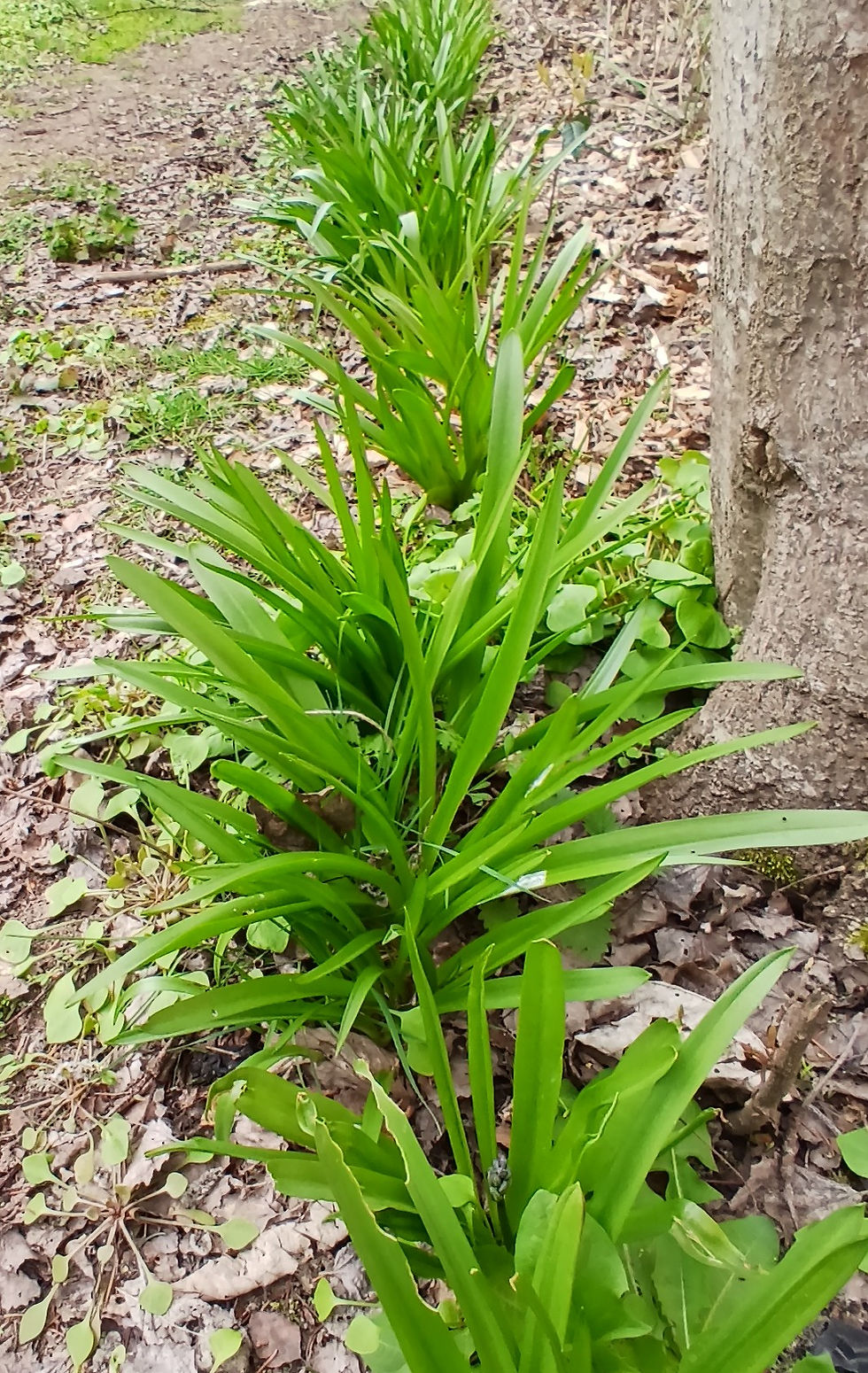
By April and May, bluebells take over and signal a shift to warmer, late spring weather. In the woodland garden of the Reverie, the bluebells create a winding carpet of blue (pictured here in March not yet in bloom).
Summer snowflakes extend the flowering period further, bridging the gap between early and late spring.
Spring moves towards summer
Alliums rise above the border and combine perfectly with the roses that are starting to blossom. By now, the garden has shifted from a low, early tapestry to a more layered composition. Then the season gradually changes again into summer.
Agapanthus and Bletilla take over, introducing a slightly more exotic atmosphere. Their presence feels warmer, more in tune with summer than with spring.
They extend the sequence beyond what is usually considered the “bulb season” and by this time, the ecological role of flowering has also shifted. In early spring, nectar is scarce and every flower matters. Later in the season, abundance replaces scarcity, and the last of the bulbs that are still flowering become one of many sources rather than one of the few.
Pictures will be added (here and on the Pinterest page) as the season continues.
A continuous rhythm
From the first snowdrops in January to the last agapanthus in summer, flowering continues for five to six months. Not as a single peak, but as a gradual unfolding.
Each plant has its moment. None dominate for long. Together, they create continuity.
It is not about filling the garden with as many flowers as possible at once. It is about allowing one group to step forward while another recedes.
The bulb season isn’t just for spring, and spring doesn’t start when the calendar says it does. Nature and gardens move and shift. The bulb season builds gradually, often already starting in January with the smallest of signs and the first snowdrops, hardly visible if you don’t go looking. And what begins with a few snowdrops in the cold becomes, months later, a garden full of colour, structure and life.
And this is the most rewarding part: not waiting for spring to start, but dressing up warm, taking your umbrella and searching for the first signs of spring. And then, for months on end, to watch and enjoy all the beauty a garden carries from winter well into summer.
Scroll on for a list of all the bulbs at the Reverie!

Bulbs in the Reverie, and what they really are
In gardening, we tend to call many spring and summer bloomers “bulbs.”
And while that works perfectly well in practice, botanically speaking there are some interesting differences. Here’s an overview of the bulbs in the Reverie gardens, with a small note where something is technically not a true bulb.
Snowdrops
Crocus
Grape hyacinths
Hyacinths
Daffodils
Tulips
Siberian squill
Spring squill
Bluebells
Iris
Alliums
Summer snowflakes
Snake’s head fritillary
Coppertips (Crocosmia)
Anemone de Caen (technically not a bulb, but a tuber)
Agapanthus (technically not a bulb, but a rhizome with fleshy roots)
Bletilla striata (technically not a bulb, but an orchid type pseudobulb)
A small botanical note
A “true bulb” is a very specific structure, layered, like an onion.
Many plants we casually call bulbs actually grow from:
tubers (like anemones)
rhizomes (like agapanthus)
pseudobulbs (like bletilla)
In the garden, though, they all behave similarly. They store energy underground and return year after year, often marking the rhythm of the seasons, allowing you to enjoy a garden that flowers for months on end.


